Animal Face Type Chart: A Quick Visual Guide to 9 Animal Face Types
A table-first guide for comparing tiger, cat, dog, deer, rabbit, horse, monkey, squirrel, and piggy face signals without guessing from one feature alone.

Editorial Note
Animal face types are entertainment-focused style language. They describe facial impression, not personality, race, or objective attractiveness.
Quick Answer
- A reliable animal face type chart compares eyes, face length, jawline, cheeks, and overall vibe together.
- Cat and tiger usually separate through strength and intensity, while dog and rabbit separate through warmth versus cuteness.
- Deer and horse often overlap on face length, but deer reads gentler while horse reads more vertical and mature.
- Most people land between two types, so a primary plus secondary match is more realistic than one fixed label.
- Use the chart to narrow your type first, then confirm it with the AI test and a clear front-facing photo.
If you searched animal face type chart, you probably want something faster than a long article and clearer than a quiz result with no explanation. The easiest way to compare animal face types is to put the core signals side by side: eye shape, face length, jawline, cheeks, overall vibe, and the type each face is commonly confused with.
This page is intentionally chart-first. It supports the broader Animal Face Types Explained article, but it serves a different intent. Instead of deep narrative explanation, this page helps you compare the nine core types quickly, then decide which one deserves a closer read.
GSC currently shows the homepage dominating broad test intent, while Semrush fallback validation shows animal face type chart and animal face types chart as low-difficulty informational long-tail queries. That makes a comparison page safer than another tool-style landing page because it fills a table-first SERP gap without competing with the upload test.
How to Use an Animal Face Type Chart
Start with a neutral, front-facing photo in natural light. Then compare your face to the chart in this order: eyes first, face length second, jawline third, cheeks fourth, and overall mood last. The biggest mistake is choosing a type based only on the label you like best.
Charts work because they reduce bias. If your eyes look lifted, your outline is clean, and your lower face is defined, cat rises quickly. If your eyes feel softer and your smile feels warm, dog becomes more likely. If your face is longer and gentle, deer or horse may be stronger depending on whether the vibe reads delicate or vertical.
Use the chart to find one primary type and one backup type. If you need a tie-breaker, compare yourself across two photos: one neutral expression and one light smile.
- Do not use a beauty filter for the first comparison.
- Compare multiple clues instead of one feature.
- Keep a secondary type when two patterns overlap.
- Use the AI test after the chart if you want a probability-style result.
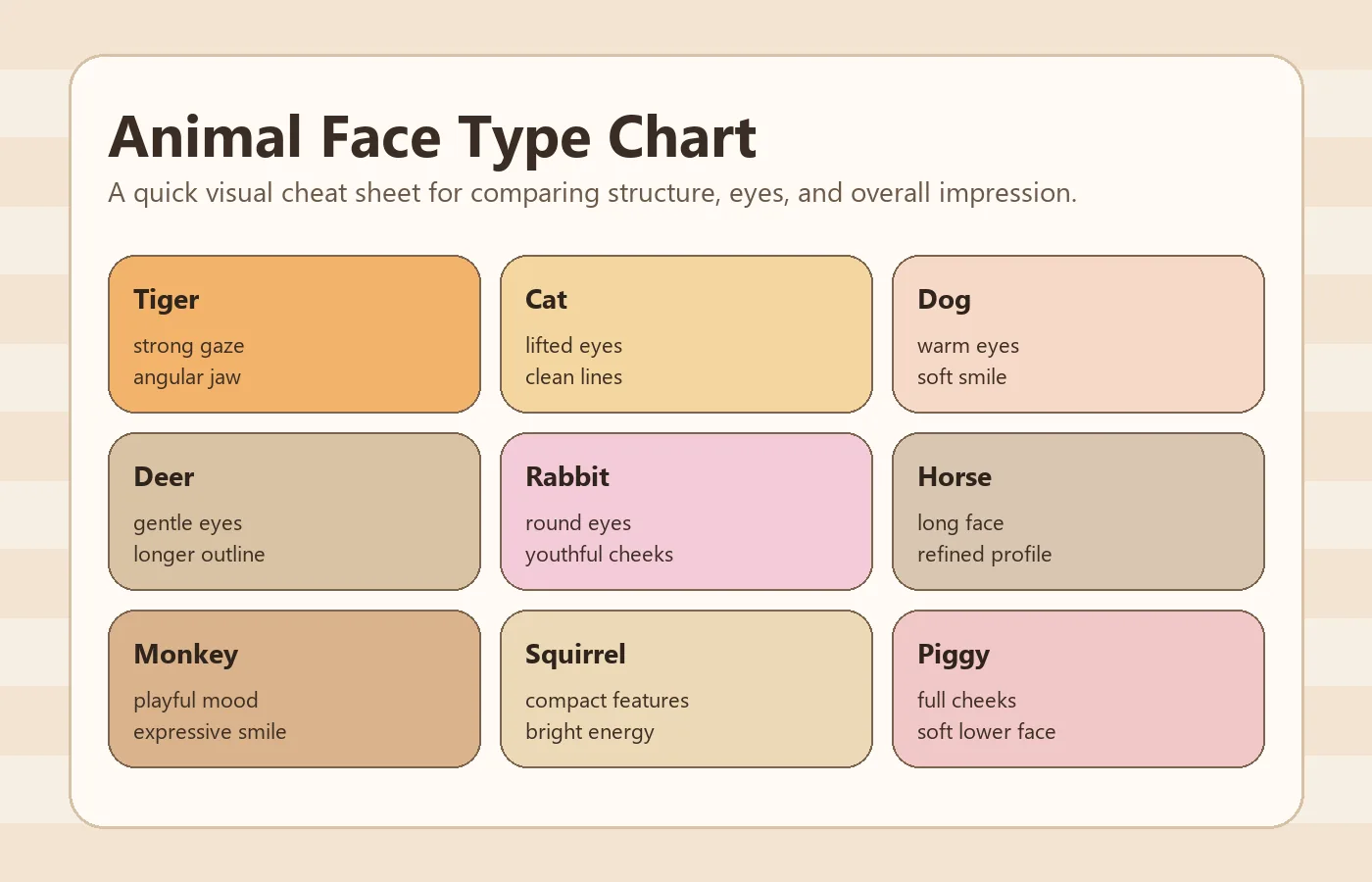
Animal Face Type Chart
This is the fastest side-by-side comparison for the nine types currently used across the site. Read each row as a pattern cluster rather than a strict definition.
| Type | Eyes and outline | Jawline and cheeks | Overall vibe | Often confused with |
|---|---|---|---|---|
| Tiger | Intense eyes, strong structure, high visual contrast | Angular or firm jawline, less softness in the lower face | Powerful, charismatic, mature | Cat when the face is sleek instead of heavy |
| Cat | Lifted almond eyes, balanced outline, cleaner lines | Defined lower face without extreme length | Polished, cool, chic | Tiger or Fox |
| Dog | Soft or open eyes, approachable expression | Gentler jawline, friendly cheeks, relaxed smile | Warm, loyal, easy to approach | Rabbit |
| Deer | Large gentle eyes, longer but delicate outline | Slim lower face, lighter jawline, graceful cheeks | Elegant, soft, calm | Horse or Rabbit |
| Rabbit | Round bright eyes, shorter or softer outline | Youthful cheeks, softer lower face | Cute, fresh, sweet | Dog or Deer |
| Horse | Longer vertical proportions, steady eye line | Longer lower face, refined profile, less cheek roundness | Mature, refined, composed | Deer |
| Monkey | Expressive eyes, animated movement, playful energy | Cheek movement matters more than static jawline | Social, witty, lively | Squirrel |
| Squirrel | Compact features, bright alert eyes, smaller scale | Tighter proportions, quick expression, less facial weight | Energetic, clever, youthful | Monkey or Rabbit |
| Piggy | Soft eyes, rounded central features | Fuller cheeks, soft lower face, gentle contour | Kind, soft, cozy | Dog or Rabbit |
Quick Grouping by Overall Vibe
If the full chart still feels crowded, group the types by the mood they create. This helps you eliminate wrong options quickly before you compare the details.
| If your face mostly feels... | Most likely group | Use this tie-breaker |
|---|---|---|
| Sharp, polished, defined | Cat or Tiger | Tiger is stronger and more forceful; Cat is cleaner and sleeker |
| Warm, soft, friendly | Dog or Piggy | Dog reads more open and social; Piggy reads rounder and softer |
| Cute, bright, youthful | Rabbit or Squirrel | Rabbit is softer and sweeter; Squirrel is smaller-featured and more alert |
| Gentle, elegant, elongated | Deer or Horse | Deer is softer and more delicate; Horse is more vertical and mature |
| Animated, playful, expressive | Monkey | If compactness becomes stronger than expression, re-check Squirrel |
Common Animal Face Type Mix-Ups
Most chart confusion comes from adjacent types. Cat versus tiger is usually about intensity. Dog versus rabbit is usually about warmth versus cuteness. Deer versus horse is usually about graceful softness versus vertical length. Monkey versus squirrel is usually about expression size versus feature size.
If two rows both feel accurate, do not force a fake certainty. Mixed results are normal because real faces do not behave like cartoon icons. A good comparison page should help you narrow the field, not pretend every face fits only one box.
| Comparison | Main difference | Better question to ask |
|---|---|---|
| Cat vs Tiger | Sleek definition versus stronger intensity | Does your face feel sharp or powerful first? |
| Dog vs Rabbit | Friendly warmth versus youthful cuteness | Do people notice softness or sweetness first? |
| Deer vs Horse | Delicate grace versus vertical refinement | Does the face feel gentle or elongated first? |
| Monkey vs Squirrel | Expressive movement versus compact brightness | Is the energy coming from expression or from feature size? |
How Photos Can Distort the Chart Result
High-angle selfies often shorten the face and exaggerate rabbit or dog signals. Low-angle shots can lengthen the face and overstate horse or tiger. Heavy filters can erase jaw definition, and strong contour makeup can fake a cat-like lower face.
That is why the chart should be used with one clean baseline image first. If your type changes drastically between photos, the photo setup is affecting the result more than your actual structure.
- Use eye-level framing in natural light.
- Keep hair off the jawline and brow line.
- Avoid wide-angle distortion for the first check.
- Compare one neutral photo and one smile photo.
What to Do After the Chart
Once you narrow your face to one or two likely types, move to a deeper explainer. If you need definitions, read Animal Face Types Explained. If you are comparing Korean beauty labels such as puppy, cat, rabbit, deer, and fox, use the Korean animal face type self-check. If you want a fast probability-style result, use the Animal Face Type Quiz or the homepage Animal Face Test.
The chart is the comparison layer, not the final verdict. Its job is to make the next step smarter.
Test Your Animal Face Type After the Chart
Use the chart to narrow your strongest two types, then upload a clear photo to see which one the AI ranks highest and what secondary signals it finds.
FAQ
References and Source Notes
-
Google Search Console site data for animalfacetest.orgUsed for current ranking-page mapping and to verify that broad test intent is already assigned to the homepage.
-
Semrush fallback keyword validationUsed because Similarweb keyword tabs returned insufficient low-difficulty data for the selected candidate topics. Semrush indicated low-difficulty support for animal face type chart and animal face types chart in the US database.
-
Animal Face Test internal guidesExisting article set used to define non-overlapping intent boundaries for the chart page.Open the main animal face types guide