Upload a clear selfie and take an animal face type quiz built for people who want more than a random personality result. This page uses AI to study visible facial cues such as eye shape, face shape, cheek fullness, jawline, and overall proportions, then compares those signals with the animal face types people search most often: puppy face, cat face, deer face, rabbit face, and fox face. The result is fast, style-oriented, and easy to understand, with one main match plus nearby types when your features overlap.
Upload Your Photo for an Animal Face Type Quiz
Use a clear front-facing selfie, or drag and drop your image here
Best results come from even lighting, a neutral expression, and a full view of your eyes, cheeks, nose, and jawline.
Analyzing...
Running Your Animal Face Type Quiz...
Our AI is comparing your visible features with the most common animal face types now.
Preparing your image...
Detecting eye shape, face outline, and lower-face structure
Comparing your features with puppy, cat, deer, rabbit, and fox signals
Writing your animal face type diagnosis
Animal face type result
Your result will show your strongest animal face type, your nearby secondary matches, and the visible features that likely drove the quiz result.
Analyzing
Your Closest Animal Face Type
Primary match--
Face vibe--
Confidence--
Why this result fits
How the other animal face types compare
How This Animal Face Type Quiz Works
Step 1
Upload one clear selfie
Start with a straight-on photo in balanced light. The cleaner the image, the easier it is for the animal face type quiz to distinguish between round eyes and lifted eyes, softer cheeks and sharper lines, or a shorter face and a longer face.
Step 2
The AI reads visible facial cues
This animal face types test is built around the features users actually care about: eye direction, jawline shape, cheek fullness, face length, nose line, and overall facial balance. It is a visual analysis workflow, not a random personality questionnaire.
Step 3
You get a main type and nearby matches
Instead of forcing one label with no context, the tool returns your top result plus a broader animal face type diagnosis. That helps explain mixed impressions such as cat with fox overlap, or deer with rabbit overlap.
What the AI Reads in an Animal Face Type Diagnosis
People searching for an animal face type quiz usually want to know what the tool is actually looking at. The strongest pages in this topic do not stop at 'upload a photo' and 'get a result'. They explain the visible signals behind the match. This section is the practical breakdown.
Signal 1
Eye shape and eye direction
Eye shape is one of the fastest ways to separate the most common animal face types.
Rounder, softer eyes often push a result toward puppy face or rabbit face.
Lifted or more almond-shaped eyes often push a result toward cat face or fox face.
Large gentle eyes inside a longer face often support a deer face read.
Signal 2
Face shape and face length
A good animal face type diagnosis does not only inspect individual features. It also reads the total silhouette of the face.
Shorter, softer, more compact proportions often feel rabbit-like or puppy-like.
Balanced sharpness without much extra length often feels cat-like.
Longer, narrower, or more directional proportions can move a result toward deer face or fox face.
Signal 3
Jawline, cheeks, and lower-face softness
Many mixed results come from tension between the eyes and the lower half of the face.
Soft cheeks and a gentle jawline usually support puppy face or rabbit face.
Cleaner lower-face lines and sharper contours usually support cat face or fox face.
A delicate jawline with refined softness often leans deer face instead of a cuter type.
Signal 4
Overall facial vibe
This animal face type quiz is entertainment-first, but it still tries to explain the overall impression people respond to when they describe a face.
Warm and approachable often maps to puppy face.
Chic and defined often maps to cat face.
Graceful and airy often maps to deer face, while cute and youthful often maps to rabbit face, and sleek or mature often maps to fox face.
The 5 Animal Face Types People Search Most Often
Not every site uses the same animal face system, but five types appear over and over in beauty explainers, face archetype articles, and animal face type quiz pages: puppy face, cat face, deer face, rabbit face, and fox face. That is why this page uses them as the core framework. It matches the search intent behind phrases like animal face types test, animal face shape quiz, and what animal do you look like quiz without pretending there is one official universal list.
Core type
Puppy Face
Puppy face sits on the warm and approachable side of the spectrum. In an animal face type quiz, puppy face usually means softer contours, kinder eye energy, and a first impression that feels friendly instead of dramatic or distant. It is one of the most common matches for users who look youthful but not especially doll-like.
Key features: rounder or gently downward eyes, softer jawline, fuller cheeks, less angular facial lines, and a generally warm expression
Overall vibe: soft, cheerful, open, approachable
Often confused with: rabbit face when the face looks even cuter and more compact, or deer face when the eyes feel large but the face is longer
Core type
Cat Face
Cat face is one of the most recognizable animal face types because the visual language is strong. Users who get cat face often have sharper lines through the eyes and chin, more definition through the cheek area, and a polished look that reads chic rather than cute.
Key features: almond or slightly lifted eyes, clearer cheekbones, sharper lower-face lines, and a more defined chin
Overall vibe: chic, cool, polished, magnetic
Often confused with: fox face when the whole face also looks longer and narrower, or deer face when the sharpness softens and the eyes get gentler
Core type
Deer Face
Deer face leans graceful, delicate, and bright-eyed. In this animal face types test, deer face is less about baby-faced cuteness and more about a gentle, airy impression. Large eyes matter here, but so does the longer or more refined overall face shape around them.
Key features: large gentle eyes, longer or slimmer proportions, refined features, delicate jawline, and lighter facial balance
Overall vibe: graceful, innocent, luminous, airy
Often confused with: rabbit face when the face becomes shorter and sweeter, or puppy face when the expression feels warmer than refined
Core type
Rabbit Face
Rabbit face is the bright, cute, youthful end of the animal face type quiz spectrum. It often appears when the eyes look round and awake, the face reads soft and compact, and the total effect feels fresh and doll-like. People who search rabbit face are often trying to separate it from puppy face or deer face.
Key features: rounder eyes, softer cheeks, smaller cute central features, younger-looking proportions, and compact facial balance
Overall vibe: cute, lively, sweet, fresh
Often confused with: puppy face when the face reads friendlier than doll-like, or deer face when the eyes stay big but the face gains length
Core type
Fox Face
Fox face is usually where users land when they feel sharper than cat in a longer, more directional way. It keeps some of the lifted-eye quality of cat face, but the face often reads narrower, more mature, and slightly more mysterious overall. That is why fox face is a high-intent comparison term in many animal face type diagnosis searches.
Key features: lifted or longer eyes, slimmer face shape, cleaner profile, more directional lines, and a mature lower-face finish
Overall vibe: sleek, refined, mature, striking
Often confused with: cat face when the face is sharp but not especially long, or bird-type beauty language on broader style sites
When to Use This Face Representative Animal Quiz
Similarweb shows new search demand around face representative animal quiz. This section explains how to use the existing tool for that intent without changing the page into a personality quiz.
Representative match
Use one portrait as your baseline
A face representative animal quiz works best when the first photo is neutral. Use it to find the animal that represents your visible face impression before testing styled photos.
Photo not personality
Separate facial cues from personality answers
This tool focuses on eye shape, face length, cheek softness, and jawline. It does not ask personality questions, so the result stays close to what people see in the photo.
Internal guide
Compare your result with the type guide
After the quiz, read the animal face types guide if your top two matches are close or if you want to understand why a result leans cat, deer, puppy, rabbit, or fox.
The Most Common Animal Face Type Quiz Confusions
People rarely search for an animal face type quiz because they want definitions only. Most want help settling a comparison. These are the two comparison patterns that show up most often in animal face types test content and beauty-language discussions.
Cat Face vs Fox Face
Both types can feature sharper or lifted eyes, so the difference usually comes from the total face shape. Cat face tends to look tighter and more compact. Fox face usually feels narrower, longer, and more directional from top to bottom.
When it leans cat face
The face is sharp, but not especially long.
The eye area feels defined and feline without making the whole face look stretched.
Cheekbone definition and chin shape matter as much as eye lift.
When it leans fox face
The eyes are lifted and the entire face also looks slimmer or more elongated.
The nose line and lower face feel cleaner and more directional.
The impression reads more mature, sleek, or mysterious than simply chic.
Quick rule: If the sharpness is concentrated in the eyes and chin, think cat face. If the whole face narrows and lengthens, think fox face.
Deer Face vs Rabbit Face
These two are often confused because both can include large eyes and soft features. The clearest difference is whether your face reads graceful and elongated or cute and compact.
When it leans deer face
Your eyes are large, but the face is longer or slimmer around them.
The total impression feels elegant, airy, or delicate.
Cheek fullness is lower and the vertical line of the face is more noticeable.
When it leans rabbit face
Your eyes are large and the face also looks shorter, softer, or more youthful.
The cheeks and center of the face add extra sweetness.
The total impression feels cute before it feels graceful.
Quick rule: If your big eyes sit inside a longer and more refined face, deer face is more likely. If they sit inside a softer, sweeter, younger-looking face, rabbit face usually fits better.
Puppy Face vs Rabbit Face
This is another high-intent split because both types can look soft and youthful. The difference usually comes from whether the softness reads friendly and relaxed or extra cute and doll-like.
When it leans puppy face
The face feels warm, open, and approachable first.
The eyes may be round, but they do not dominate the result with an extra doll-like effect.
The smile or general friendliness of the face is a big part of the read.
When it leans rabbit face
The face looks softer and more compact overall.
The eyes and cheeks create a younger, sweeter, more playful center.
The result feels cute first, friendly second.
Quick rule: If your softness feels warm and approachable, puppy face is usually stronger. If it feels cuter and more youthful, rabbit face is usually stronger.
Why Your Animal Face Types Test Result Can Be Mixed
Real faces rarely fit into one label perfectly, which is why a useful animal face type diagnosis should show nearby matches instead of pretending every face is pure puppy face or pure cat face.
A single photo can easily combine signals from two or three types at once. You might have cat-like eye lift, rabbit-like cheek softness, and a deer-like facial silhouette. That does not mean the quiz failed. It means your face sits near the border between multiple animal face types, which is normal.
Photo conditions also matter. Makeup, bangs, camera distance, facial expression, and lighting can all shift the final read. A glam photo may push a softer face toward cat or fox. A washed-out selfie may flatten definition and push a sharper face toward puppy or rabbit. The most useful way to read the result is to treat the top type as your base archetype and the second type as a clue about why people sometimes describe your features differently.
Use this checklist before taking the result too literally
Test one clear neutral selfie before judging glam, heavy makeup, or dramatic angle photos.
Look at your secondary matches, not only the highest percentage in the animal face type quiz.
If your result changes a lot between photos, compare your eye shape and face length first.
Treat animal face types as style-oriented descriptors, not scientific identity labels.
Example Looks This Animal Face Type Quiz Can Separate
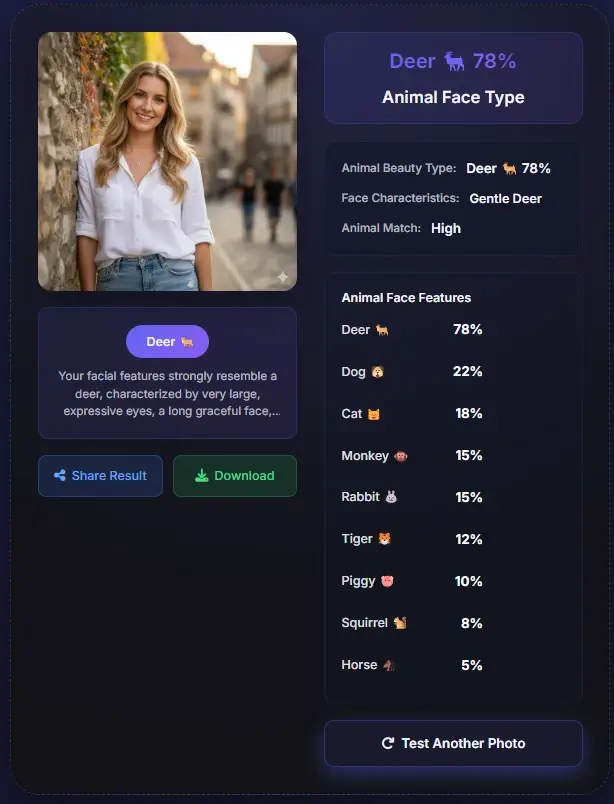
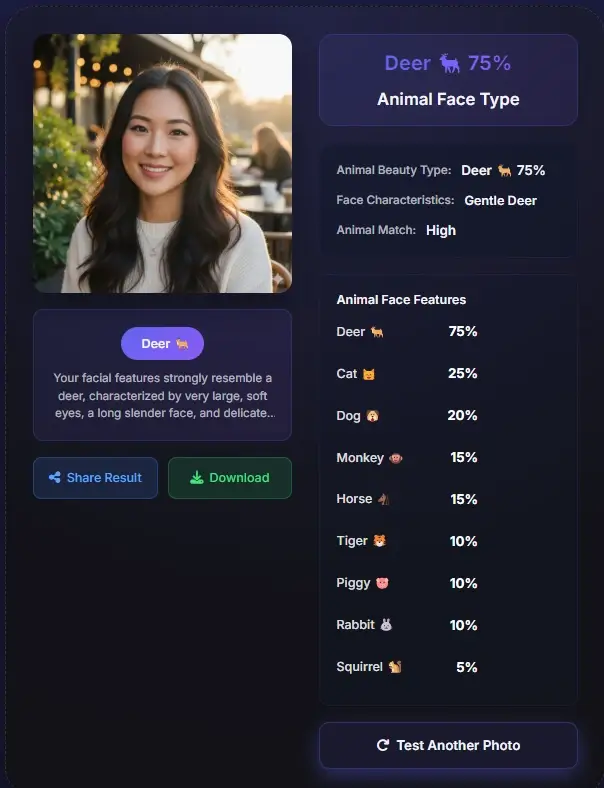
These example photos are here to show the range the tool is designed to distinguish: softer puppy energy, gentle deer-like balance, and sharper or more directional face language.
Animal Face Type Quiz FAQ
What is an animal face type quiz?
An animal face type quiz is a visual face-archetype test that compares your visible features with common animal face categories such as puppy face, cat face, deer face, rabbit face, and fox face. This page uses photo-based AI analysis rather than a simple personality questionnaire.
How is this different from a random personality quiz?
A random personality quiz usually asks opinion-based questions and assigns a result for entertainment. This animal face type quiz analyzes visible facial cues such as eye shape, face length, jawline, cheek fullness, and overall proportions to explain why one type fits better than another.
What facial features does the AI analyze?
The tool looks at visible signals including eye shape, eye direction, face shape, jawline, cheek volume, nose line, and facial proportions. Those signals are then compared with the common patterns behind puppy face, cat face, deer face, rabbit face, and fox face.
What is the difference between an animal face type quiz and an animal face type diagnosis?
On this page, quiz is the lighter entry point and diagnosis refers to the feature-by-feature explanation behind the result. The experience is still entertainment-first, but the diagnosis framing helps explain what the AI saw instead of giving you a label with no context.
Can I match more than one animal face type?
Yes. Mixed results are common. Many faces combine signals from two nearby categories, such as cat face with fox overlap or deer face with rabbit overlap. That is why this animal face types test shows your nearby matches instead of only one hard label.
Does makeup, lighting, or angle affect the result?
Yes. Makeup can sharpen or soften the eye area, lighting can flatten or increase definition, and camera angle can change face length and jawline appearance. For the most stable animal face type quiz result, use a clear front-facing selfie in even light.
Is animal face analysis scientific?
No. Animal face analysis is best understood as a visual style and beauty-language tool, not a scientific classification system. It can still be useful for describing facial impressions, but it should not be treated as a medical, psychological, or scientific diagnosis.
What is a face representative animal quiz?
A face representative animal quiz finds the animal face type that best represents your visible facial impression. This page uses a selfie-based workflow, so the answer comes from facial cues rather than personality questions.
Can this quiz tell what animal face I have?
Yes. Upload a clear selfie and the quiz compares your features with common animal face types such as puppy, cat, deer, rabbit, and fox, then explains the closest and secondary matches.