Animal Face Shapes: A Practical Guide to Matching Face Outline With Animal Face Types
Use face length, jawline, cheeks, chin, and feature scale to separate cat, fox, deer, rabbit, dog, tiger, horse, squirrel, and monkey impressions.

Editorial Note
Animal face shapes are entertainment-focused style language. They are not a medical, biometric, ethnic, or attractiveness judgment.
Quick Answer
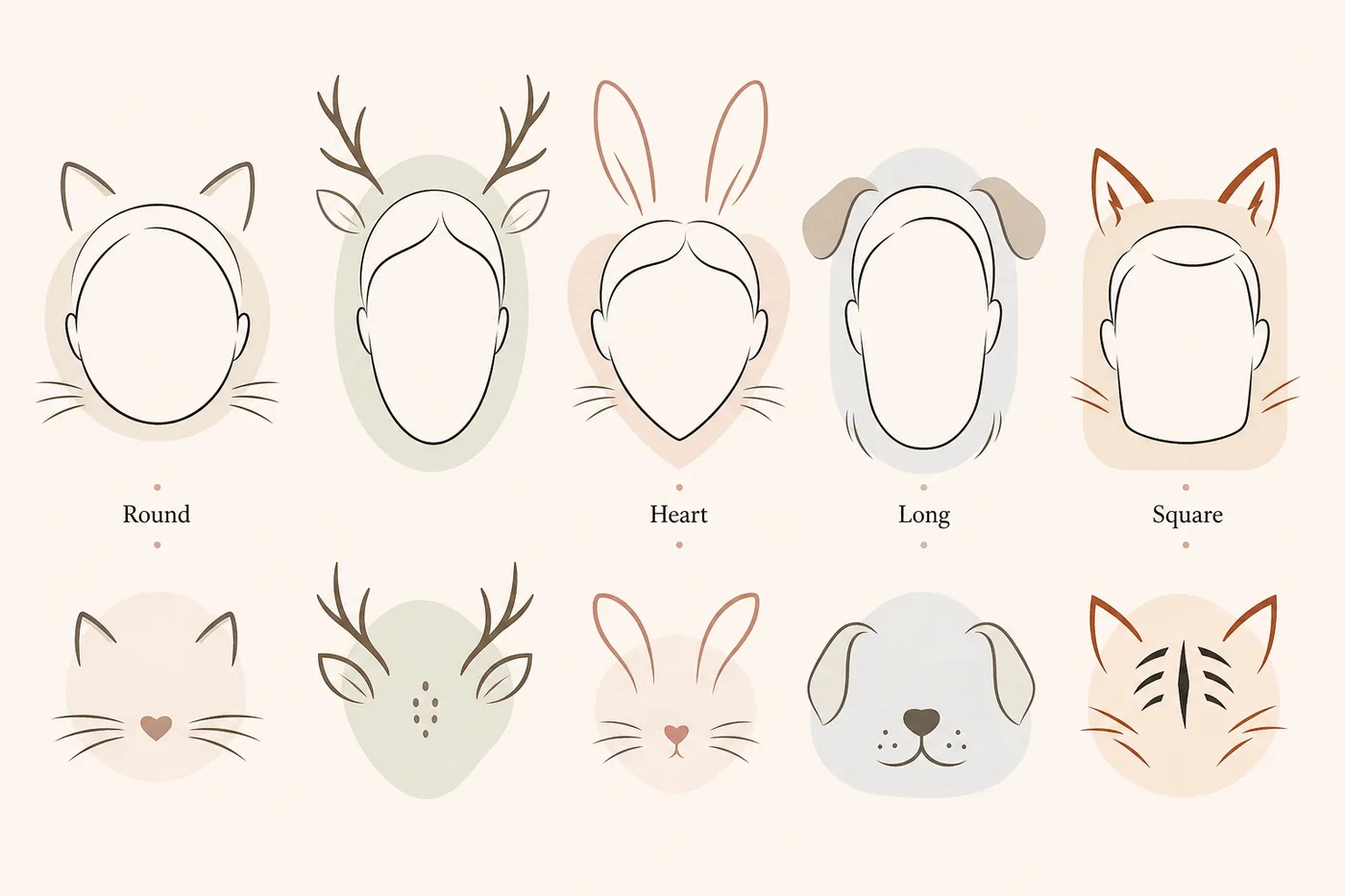
- Round and soft face shapes often point toward rabbit, dog, puppy, or piggy impressions.
- Long and gentle face shapes often support deer or horse readings, depending on eye softness and vertical proportions.
- Heart, V-line, and sharper lower-face shapes often support cat or fox readings.
- Broad, angular, or high-contrast face shapes can support tiger, especially when the eyes and brow feel intense.
- Face shape is only one layer, so confirm it with eye type, cheeks, nose, expression, and a clear front-facing photo.
If you searched animal face shapes, you are probably trying to turn a normal face-shape label such as round, oval, heart, long, square, or V-line into an animal face type. This guide focuses on that missing step. It explains how face outline changes the read of cat, fox, deer, rabbit, dog, tiger, horse, squirrel, monkey, and piggy face impressions.
The short version: soft rounded outlines usually support cute and approachable types, while sharper or longer outlines push the result toward sleek, elegant, or intense types. But animal face type is never only the outline. A round face with lifted eyes may read cat-rabbit; a long face with large gentle eyes may read deer; a sharp V-line with calm eyes may read cat rather than fox.
Use this guide as the face-shape layer before you compare your result with the Animal Eye Type Guide, the Animal Face Type Chart, or the Animal Face Type Quiz. GSC and Similarweb evidence point to face-shape and deer face type wording as useful support for the existing guide, not a reason to create a new page.
The 6-Step Method for Reading Animal Face Shapes
Start with a clear front-facing photo at eye level. Ignore makeup, hairstyle, and pose for a moment. Trace the outer outline from temple to cheek, jaw, chin, and back up the other side. Then answer six practical questions: is the face longer than it is wide, are the cheeks full or flat, is the jaw soft or angular, is the chin rounded or pointed, are the features compact or stretched, and does the whole face read soft, sharp, graceful, intense, or playful?
This method keeps the result from becoming a single-word face shape test. Two people can both have oval faces but read very differently: one may look deer-like because the eyes are gentle and the face is long; another may look cat-like because the chin is cleaner and the eye line is lifted.
- Length: short, balanced, or long vertical proportion.
- Cheeks: full and soft, balanced, hollow, or high and defined.
- Jawline: rounded, tapered, V-shaped, square, or angular.
- Chin: soft, small, pointed, long, or strong.
- Feature scale: compact, balanced, delicate, or elongated.
- Impression: cute, gentle, sleek, alert, playful, elegant, or powerful.
Animal Face Shape Map: Which Face Outlines Point to Which Animal Type?
The table below connects common outline signals with likely animal types. Read it as a probability guide: a longer, gentle oval often supports a deer face type, while a shorter soft outline may support rabbit or dog. The phrase deer type face is simply a word-order variation, not a separate system.
| Face shape signal | Likely animal face type | Tie-breaker |
|---|---|---|
| Round face, soft cheeks, small chin | Rabbit, Dog, Puppy, or Piggy | Rabbit is brighter and cuter; Dog/Puppy is warmer; Piggy is softer and rounder. |
| Long face with gentle proportions | Deer or Horse | Deer needs soft large eyes; Horse needs stronger vertical elegance and elongated features. |
| Heart face or V-line chin | Cat or Fox | Cat reads refined and balanced; Fox reads sharper, narrower, and more slanted. |
| Angular jaw with strong brow or high contrast | Tiger | Tiger needs intensity, not just a square jaw. |
| Compact face with small delicate features | Squirrel | Look for alert eyes, small nose, and a quick, bright expression. |
| Expressive face with mobile features | Monkey | Expression and smile movement matter more than a perfect outline. |
| Oval balanced face | Mixed type | Use eyes, cheeks, and jawline to separate cat-deer, dog-deer, rabbit-cat, or horse-deer. |
Soft vs Sharp Animal Face Shapes
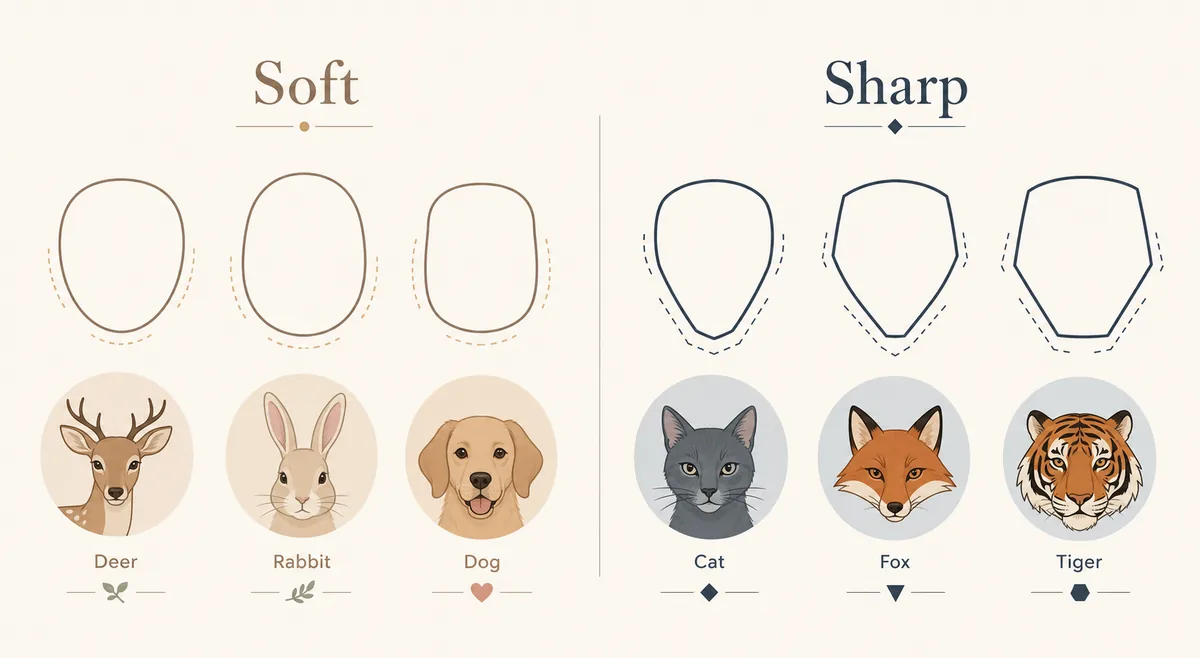
Most animal face shape confusion starts with the soft-versus-sharp split. Soft types are built from rounded cheeks, gentle transitions, smaller angles, and a friendlier first impression. Sharp types are built from cleaner lines, tapered chins, stronger cheekbones, narrower eye direction, or higher contrast between features.
Soft does not automatically mean rabbit, and sharp does not automatically mean cat. A soft long face can be deer. A sharp wide face can be tiger. A compact soft face can be squirrel or puppy. The best read comes from pairing the outline with eye type and expression.
Soft Shape Family
Rounded cheeks, soft jawlines, gentle transitions, and a warm or youthful impression.
- Signature shape signals: round outline, cheek fullness, small chin, soft lower face
- Overall impression: rabbit, dog, puppy, piggy, sometimes deer
- Often confused with: rabbit vs puppy, deer vs dog, piggy vs rabbit
Sharp Shape Family
Cleaner lines, tapered lower face, defined cheekbones, or a more intense first impression.
- Signature shape signals: V-line chin, angular jaw, high cheekbones, narrower visual flow
- Overall impression: cat, fox, tiger, sometimes horse
- Often confused with: cat vs fox, tiger vs cat, horse vs deer
Common Animal Face Shape Mix-Ups
Cat versus fox is the most common sharp-shape mix-up. Both can have a V-line or refined lower face, but cat usually feels cleaner, balanced, and polished. Fox usually feels narrower, more slanted, and more sly. If your face outline is sharp but your eyes are calm and balanced, cat is usually the safer first guess.
Deer versus horse is the common long-shape mix-up. Deer depends on softness and large gentle eyes. Horse depends more on vertical length, straightness, and a refined elongated impression. Rabbit versus puppy is the common round-shape mix-up: rabbit feels bright and cute, while puppy feels warm, open, and emotionally soft.
Tiger can be mistaken for cat when the lower face is sharp. The difference is intensity. Tiger needs stronger brow, higher contrast, or a more commanding expression. Without that intensity, a sharp face is more likely cat or fox.
| Mix-up | Choose the first type when... | Choose the second type when... |
|---|---|---|
| Cat vs Fox | The outline is sharp but balanced and polished. | The face reads narrower, more slanted, and more sly. |
| Deer vs Horse | The face is long but soft, gentle, and eye-led. | The face is long, straight, elegant, and feature-led. |
| Rabbit vs Puppy | The roundness feels bright, cute, and youthful. | The softness feels warm, friendly, and emotionally open. |
| Tiger vs Cat | The shape has strength, contrast, and commanding intensity. | The sharpness feels sleek, refined, and controlled. |
| Squirrel vs Rabbit | The face and features are compact, alert, and delicate. | The main signal is round cuteness and brighter eyes. |
How to Check Your Animal Face Shape in Photos
Photo setup can change your animal face shape more than people expect. A high-angle selfie can shorten the face and enlarge the upper cheeks, pushing the read toward rabbit or puppy. A low-angle photo can lengthen the jaw and strengthen the chin, pushing the read toward horse, tiger, or cat. Side lighting can make cheekbones look sharper, while flat front lighting can make the face look rounder.
Use two baseline photos before deciding: one neutral front-facing photo and one natural smile at eye level. If the result changes a lot between the two, treat your face as a mixed type. For example, neutral may read cat because of the jawline, while smile may read dog because warmth and cheek softness become stronger.
- Use eye-level camera height and avoid wide-angle distortion.
- Keep hair away from the jaw and cheek outline.
- Compare neutral expression with a relaxed smile.
- Check face length and jawline before choosing an animal label.
- Use the AI quiz after the manual check, not instead of it.
Limits, Privacy Notes, and What Face Shape Cannot Prove
Animal face shapes are a style vocabulary, not a scientific identity system. They should not be used to judge ethnicity, health, personality, or attractiveness. The value is practical language: it helps you describe visual impressions and compare why one photo reads deer while another reads cat-rabbit or dog-deer.
If you upload a photo, use an image you are comfortable processing online and review the Privacy Policy. For private or sensitive portraits, use the checklist manually and skip upload-based tools.
Check Face Shape Against the Full Animal Face Type
Pick your top two face-shape signals, then compare them with eye type and run the AI quiz for a full-face result.
FAQ
References and Source Notes
-
Google Search Console site data for animalfacetest.orgUsed to confirm that no default-threshold 10-30 position query required editing an existing ranking page.
-
Similarweb keyword generator tabsUsed to compare phrase-match, related-keyword and question candidates for the existing animal face shapes page.
-
Similarweb keyword generator tabsUsed to compare phrase-match, related-keyword and question candidates for the existing animal face shapes page.
-
Animal Eye Type GuideInternal companion guide for checking the eye layer after face shape.Open the animal eye type guide