What Is My Animal Eye Type? A Practical Guide to Eye Shapes and Animal Face Types
Use eye direction, openness, spacing, softness, and expression to narrow your animal face type before you upload a photo.

Editorial Note
Animal eye type is entertainment-focused style language. It is not a medical, biometric, ethnic, or attractiveness judgment.
Quick Answer
- Your animal eye type is usually read from eye direction, openness, spacing, eyelid weight, and expression together.
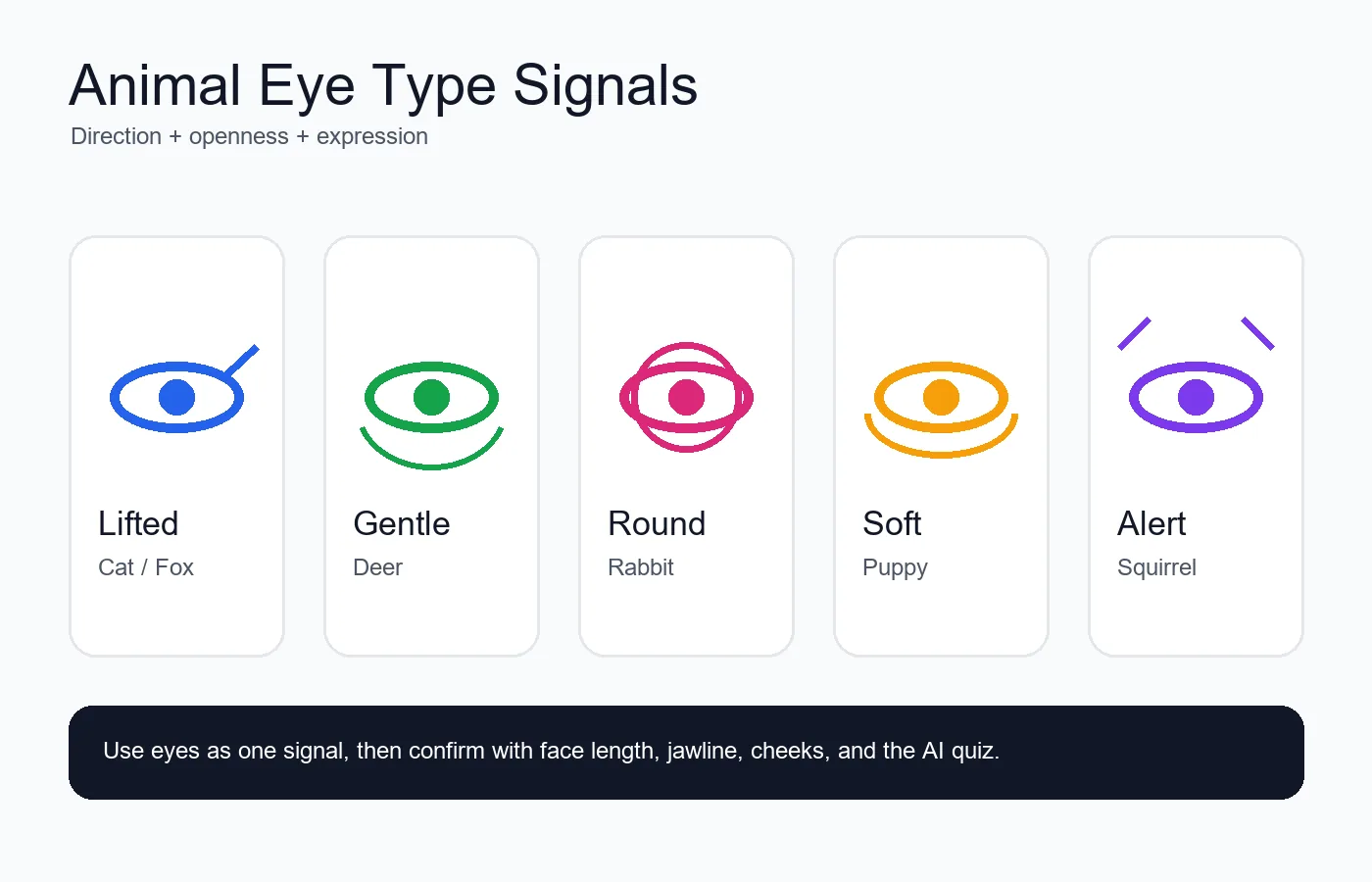
- Lifted almond eyes often support cat or fox impressions; intense lifted eyes can push toward tiger.
- Large gentle eyes often support deer; round bright eyes often support rabbit; soft open eyes often support puppy or dog.
- Small alert eyes can support squirrel, while expressive mobile eyes can support monkey.
- Eye type is only one signal, so confirm it with face length, jawline, cheeks, and a clear front-facing photo.
If you searched what is my animal eye type, you probably noticed that most animal face guides mention eyes but do not explain how to read them. This page fills that gap. It focuses on the eye signals behind cat, fox, deer, rabbit, puppy, tiger, squirrel, monkey, and other animal face impressions.
The goal is not to reduce your whole face to one feature. Eyes can strongly influence the first impression, but animal face type works best when eye type is combined with face length, jawline, cheek softness, and overall expression. Use this guide as a pre-check, then compare your result with the Animal Face Type Quiz or the broader Animal Face Type Chart.
Opportunity note: GSC did not show a high-impression 10-30 ranking query in the last 28 days, so this page comes from Similarweb-first fallback discovery. Similarweb surfaced low-difficulty eye-type adjacency around animal face searches, while Semrush fallback confirmed the broader Korean animal face type cluster has meaningful US demand without needing another duplicate upload-test page.
The 5-Step Method for Finding Your Animal Eye Type
Start with a neutral, front-facing photo at eye level. Look at your eyes before you judge the rest of the face. Ask five questions in order: do the outer corners lift or drop, are the eyes round or narrow, are they wide-set or close-set, do the lids feel heavy or clear, and does the expression read soft, sharp, gentle, or alert?
Do not choose a type because a label sounds flattering. A cat eye reading usually needs lifted shape and cleaner definition. A deer eye reading usually needs openness plus gentleness. A rabbit eye reading depends more on round brightness and youthful softness. A puppy or dog eye reading depends on approachable warmth rather than just eye size.
- Outer-corner direction: lifted, neutral, or downturned.
- Openness: round and bright, narrow and sleek, or large and gentle.
- Spacing: compact, balanced, or wide-set.
- Lid weight: clear lid space, hooded softness, or heavier brow shadow.
- Expression: sharp, warm, gentle, alert, playful, or intense.
Animal Eye Type Map: Which Eye Signals Point to Which Face Type?
The table below maps common eye signals to animal face type tendencies. Read it as a probability guide, not a strict diagnosis. Many people have a primary and secondary eye type.
| Eye signal | Most likely animal face type | Tie-breaker |
|---|---|---|
| Lifted almond eyes | Cat or Fox | Cat is cleaner and balanced; Fox is narrower and sharper. |
| Intense lifted eyes | Tiger | Look for stronger brow presence and higher visual contrast. |
| Large gentle eyes | Deer | Usually pairs with longer, softer facial proportions. |
| Round bright eyes | Rabbit | Often paired with youthful cheeks and a softer lower face. |
| Soft open eyes | Dog or Puppy | Warmth and approachability matter more than exact roundness. |
| Small alert eyes | Squirrel | Compact features and quick expression strengthen the match. |
| Highly expressive eyes | Monkey | Expression movement matters more than static eye shape. |
| Steady elongated eye line | Horse | Usually appears with longer vertical face proportions. |
Photo, Expression, and Makeup Factors That Change Your Eye Type
Eye type is very sensitive to photo setup. A high-angle selfie can make eyes look rounder and more youthful, which can exaggerate rabbit or puppy signals. A low-angle photo can make the brow line feel heavier and push the result toward tiger or horse. Harsh overhead light can hide the lower eyelid and make the eyes look narrower than they are.
Makeup also changes the read. Long winged liner can create cat or fox direction. Soft lower-lash shading can increase deer or puppy softness. Circle lenses can push rabbit or deer. For the first check, use a clean baseline photo before comparing styled looks.
- Use eye-level camera height for the baseline check.
- Avoid beauty filters, heavy winged liner, and strong color contacts at first.
- Keep hair and glasses from covering the brow and outer corners.
- Compare one neutral expression with one natural smile.
Common Animal Eye Type Mix-Ups
The most common confusion is cat versus fox. Both can look lifted, but cat reads cleaner and more balanced, while fox reads narrower, sharper, and more slanted. Deer versus rabbit is another frequent mix-up: deer reads gentle and elongated, while rabbit reads rounder, brighter, and more youthful.
Puppy versus rabbit depends on warmth. Puppy eyes feel open, friendly, and emotionally soft; rabbit eyes feel cute, bright, and often more rounded. Tiger versus cat depends on intensity. Tiger eyes feel stronger and more commanding, while cat eyes feel sleek and polished.
How to Use Eye Type With the AI Animal Face Quiz
Once you have a likely eye type, compare it with your full-face signals. If your eyes suggest cat but your face length is soft and your cheeks are gentle, you may be cat-deer rather than pure cat. If your eyes suggest rabbit but your smile reads very warm, dog-rabbit may be more realistic.
Use the AI quiz after the manual check. Upload one neutral photo first, then one light-smile photo if you want to see whether expression changes the result. If the result shifts heavily, treat your face as a mixed type and read the explanation rather than chasing one fixed label.
Limits, Privacy Notes, and What Eye Type Cannot Prove
Animal eye type is a style and self-discovery framework, not a scientific classification. It should not be used to judge identity, ethnicity, health, personality, or attractiveness. It is useful because it gives people a shared vocabulary for visual impressions, but it remains interpretive.
If you upload a photo, use a portrait you are comfortable processing online and review the Privacy Policy. For sensitive or private images, use the manual checklist and skip upload-based tools.
Check Your Eye Type Against the Full Face
Use this guide to choose your top two eye-type signals, then run the AI quiz to compare them with face length, jawline, cheeks, and overall expression.
FAQ
References and Source Notes
-
Google Search Console site data for animalfacetest.orgUsed to verify that no default-threshold GSC query justified an existing-page edit and that broad test intent belongs to current test pages.
-
Similarweb keyword tabsUsed as fallback discovery for eye-type adjacency around animal face searches when GSC opportunities were too thin.
-
Animal Face Type ChartUsed as the internal comparison layer that this eye-focused article supports.Open the animal face type chart