Animal Face Types Men: 9 Male Animal Face Signals and How to Check Yours
A practical guide to reading male animal face types from facial structure, expression, grooming, photo angle, and AI test results.

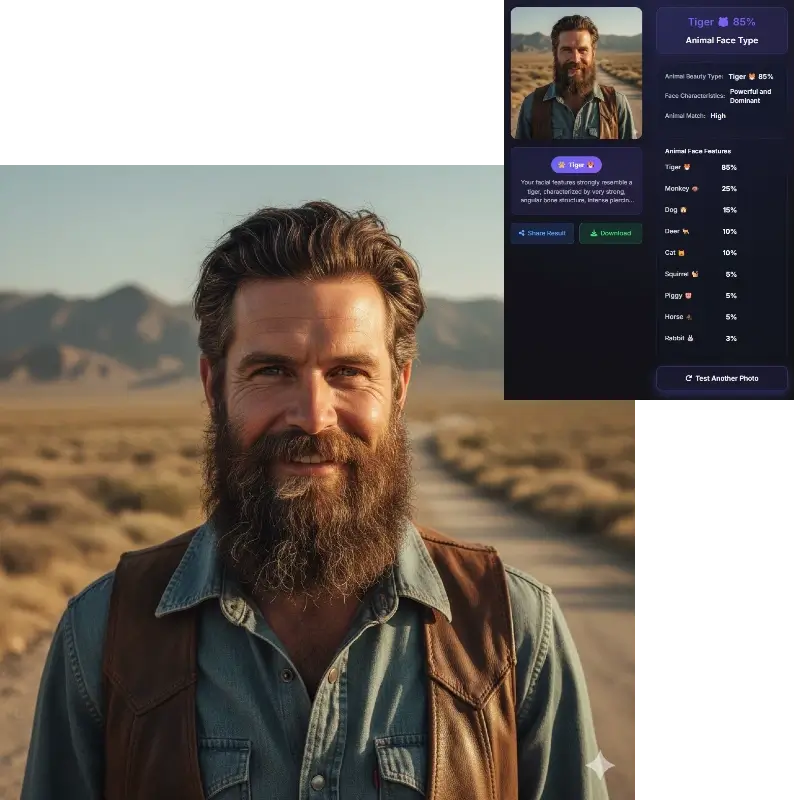
Editorial Note
Animal face types are entertainment-focused style language. They are not medical, biometric, or personality assessments.
Quick Answer
- Animal face types for men describe visual impression, not attractiveness or personality.
- The strongest male signals usually come from eye shape, brow weight, jawline, face length, cheeks, and expression.
- Tiger, cat, horse, and fox-adjacent reads often feel sharper or more mature; dog, rabbit, deer, and squirrel reads often feel warmer or softer.
- Most men are mixed types, such as tiger-cat, dog-rabbit, deer-horse, or cat-deer.
- Use a neutral front-facing photo first, then compare the result with a smile photo before deciding your type.
Searches for animal face types men usually come from a very specific question: how do animal face labels work when the face has more masculine structure, heavier brows, stronger jawlines, facial hair, or shorter hairstyles? The answer is not to force every man into a cute beauty label. It is to read the same animal face system through male facial proportions and presentation.
This page is intentionally different from the homepage Animal Face Test. The homepage is the photo upload tool. This guide explains how to think about the result before or after you upload a photo: which signals point toward tiger, cat, dog, deer, rabbit, horse, monkey, squirrel, or piggy, and why two photos of the same person can produce different impressions.
GSC data shows this site already has strong visibility for broad animal face type terms, while Similarweb keyword validation shows animal face types men as a low-difficulty informational long-tail query. Because the intent is specifically male interpretation, it deserves a supporting guide rather than another generic tool page.
What Do Animal Face Types Mean for Men?
Animal face types are a shorthand for facial impression. For men, the same labels still apply, but the deciding clues can look different. A cat face on a woman may be described through eyeliner-like eyes and a neat lower face. A cat face on a man may show up as lifted eyes, sharper cheekbones, a composed expression, and a cleaner jawline.
Male animal face analysis often gives more weight to brow shape, jaw definition, face length, and the way facial hair changes the lower face. A strong jaw can push a result toward tiger or horse, but if the eyes are lifted and the lines are sleek, the same face may read cat. If the jaw is softer and the eyes feel warm, the result may move toward dog or rabbit.
Use the labels lightly. They are style-language and entertainment, not a scientific category. The useful question is not “Which box do I belong in forever?” but “Which animal label explains the largest number of visible features in this photo?”
- Read animal face types as a cluster of clues rather than one feature.
- Expect stronger brow and jaw signals to influence male results.
- Use mixed labels when one animal explains the eyes and another explains the lower face.
The Male Feature Signals That Matter Most
Start with the eyes because they usually set the first impression. Rounder, softer eyes point toward dog, rabbit, or deer. Lifted almond eyes point toward cat or tiger. Long, calm eyes can support horse or deer depending on face length. Lively eyes and cheek movement can support monkey or squirrel.
Then look at structure. A broad or defined jawline can make a face feel tiger-like, especially with intense eyes. A long vertical face can move toward horse. A narrow and polished lower face often supports cat. Softer cheeks and a relaxed smile can pull the result toward dog or rabbit, even if the jaw is not perfectly round.
Finally, compare expression and styling. A neutral expression can make a man read more cat, tiger, or horse. A warm smile can reveal dog or rabbit signals. Short hair may expose the brow and jaw, while facial hair can strengthen or hide the lower-face cue.
| Feature | What to look for | Likely direction |
|---|---|---|
| Eyes | Lifted, focused, almond, or intense | Cat or Tiger |
| Eyes | Round, open, gentle, or droopy | Dog, Rabbit, or Deer |
| Jawline | Strong, broad, angular, or visually dominant | Tiger or Horse |
| Face length | Longer and vertical with refined proportions | Horse or Deer |
| Cheeks | Soft, youthful, or friendly | Dog, Rabbit, or Piggy |
| Expression | Animated, playful, high energy | Monkey or Squirrel |
The 9 Male Animal Face Types
Use these descriptions as pattern clusters, not rigid labels.
The Animal Face Test uses a 9-animal system, so this guide keeps the same categories for consistency. Some men will match one type clearly. Many will sit between two types, which is usually more realistic.
When you compare yourself, do not choose the type you like best. Choose the type that explains your eyes, outline, jaw, cheeks, and expression together.
Tiger Face
Tiger face reads powerful, bold, and high-impact. On men, it often shows through intense eyes, stronger brow weight, a defined jawline, and a confident neutral expression.
- Signature features: strong brow, angular jaw, intense gaze, high facial contrast
- Overall impression: commanding, mature, charismatic
- Often confused with: cat when the lines are sleek rather than heavy
Cat Face
Cat face reads sleek, polished, and controlled. Male cat faces often have lifted eyes, cleaner cheekbones, a narrower lower face, and a composed expression.
- Signature features: almond eyes, lifted outer corners, defined cheekbones, neat jawline
- Overall impression: cool, stylish, elegant
- Often confused with: tiger when the structure is stronger
Dog Face
Dog face reads warm and approachable. On men, it can come from softer eyes, an open smile, rounded cheeks, and a lower face that feels friendly rather than severe.
- Signature features: soft eyes, friendly smile, gentle cheeks, relaxed expression
- Overall impression: loyal, warm, approachable
- Often confused with: rabbit when the cuteness is stronger
Deer Face
Deer face reads gentle and graceful. Male deer faces often combine larger calm eyes with a slimmer or longer outline and delicate proportions.
- Signature features: large gentle eyes, slim face, softer jaw, refined nose line
- Overall impression: gentle, graceful, sensitive
- Often confused with: horse when the face is longer
Rabbit Face
Rabbit face reads youthful and bright. For men, it usually appears through rounder eyes, a shorter soft outline, cheek fullness, and a fresh smile.
- Signature features: round eyes, youthful cheeks, softer lower face, bright smile
- Overall impression: cute, fresh, friendly
- Often confused with: dog when the warmth is stronger
Horse Face
Horse face reads long, elegant, and mature. The signal usually comes from vertical proportions, a longer nose line, and a refined but not overly soft structure.
- Signature features: longer face, straight nose line, vertical balance, steady expression
- Overall impression: refined, calm, mature
- Often confused with: deer when the eyes are softer
Monkey Face
Monkey face reads lively and expressive. On men, it often appears in mobile expressions, playful eyes, strong cheek movement, and a social first impression.
- Signature features: animated eyes, expressive smile, lively cheeks, playful energy
- Overall impression: fun, witty, social
- Often confused with: squirrel when the features are smaller
Squirrel Face
Squirrel face reads alert, compact, and bright. Male squirrel types often have smaller features, a quick expression, and a youthful but not necessarily soft impression.
- Signature features: compact proportions, bright eyes, small nose, quick expression
- Overall impression: clever, alert, energetic
- Often confused with: rabbit when the cheeks are rounder
Piggy Face
Piggy face reads soft, round, and gentle. In male results, it may show as full cheeks, a soft nose area, and a friendly rounded lower face.
- Signature features: full cheeks, soft nose, rounded lower face, gentle expression
- Overall impression: soft, kind, easygoing
- Often confused with: dog when the warmth dominates
How Grooming, Facial Hair, and Photos Change the Result
Men's animal face type results can shift quickly because styling changes the visible structure. Facial hair can sharpen the jaw and make the face read more tiger, horse, or cat. A clean shave can reveal cheek softness and move the same face toward dog, rabbit, deer, or piggy. Hair that covers the forehead can hide brow weight, while shorter hair exposes it.
Camera angle matters just as much. A low-angle photo lengthens the lower face and can exaggerate horse or tiger signals. A high-angle selfie can shorten the face and make rabbit or dog signals stronger. Wide-angle phone lenses can enlarge the center of the face and distort the nose or cheeks.
For the cleanest baseline, take one front-facing photo at eye level with natural light, neutral expression, and the full jawline visible. Then test a second photo with a relaxed smile. If the same primary animal appears in both, that is probably your base type.
- Use eye-level camera placement for your first test.
- Try both clean-shaven and facial-hair photos if your look changes often.
- Keep hair away from the brow and jawline for the baseline photo.
- Compare a neutral photo with a soft-smile photo.
- Do not judge your type from one filtered selfie.
A Simple Self-Check for Men
Use this process before reading an AI result. First, describe your eyes without naming an animal: round, lifted, long, intense, gentle, lively, or droopy. Second, describe your outline: short and soft, balanced and defined, long and vertical, or broad and strong. Third, describe your lower face: rounded, narrow, sharp, full, or heavy.
Now choose the animal that explains the most categories. If your eyes are lifted, your lower face is narrow, and your expression is composed, cat is a strong candidate. If your eyes are intense, your jaw is strong, and your brow feels dominant, tiger may fit better. If your eyes are soft and your expression feels open, dog or rabbit may explain more than a sharper label.
If two labels both make sense, keep both. A tiger-cat result is useful because it says the face is strong but also sleek. A deer-horse result says the face is long and elegant but still gentle. A dog-rabbit result says the face is warm and cute rather than severe.
| If your strongest clue is... | Check this next | Likely result |
|---|---|---|
| Intense eyes plus strong jaw | Brow weight and facial contrast | Tiger |
| Lifted eyes plus clean lower face | Cheekbone and jaw definition | Cat |
| Soft eyes plus warm smile | Cheeks and lower-face softness | Dog |
| Large gentle eyes plus slim outline | Face length and delicacy | Deer |
| Round eyes plus youthful cheeks | Shorter face and bright expression | Rabbit |
| Long vertical face plus calm expression | Nose line and jaw balance | Horse |
How to Use an AI Animal Face Test for a Male Result
The best way to use an AI result is to treat it as a structured second opinion. Upload a neutral photo first, read the percentage spread, and check whether the explanation matches what you can see. The top animal matters, but the second and third matches often explain the result more accurately.
If you get tiger as the top result and cat as a secondary result, the tool may be reading strength plus sleekness. If dog and rabbit are close, it may be reading warmth plus youthful softness. If deer and horse appear together, face length and gentle eyes are probably both influencing the result.
After reading this guide, try the Animal Face Test and compare your score with the manual checklist. For broader background, read Animal Face Types Explained. For Korean beauty labels, use the Korean Animal Face Types Test.
Find Your Male Animal Face Type
Upload a clear photo and compare your AI result with the male feature checklist above.
FAQ About Animal Face Types for Men
Research and Sources
-
Similarweb keyword validationUsed as directional keyword evidence for the male-specific long-tail query.
-
Google Search Console opportunity dataUsed to compare current ranking pages and avoid duplicating homepage tool intent.
-
K-beauty backgroundContext for animal face labels in Korean beauty and global search behavior.K-beauty overview