How to Find Which Korean Animal Face Type You Are: 5-Step Self Check
A practical guide to figuring out whether your face reads more puppy, cat, rabbit, deer, or fox, with comparison tables, photo tips, and clear mixed-type rules.

Editorial Note
Korean animal face types are a beauty and pop-culture language, not a medical, scientific, or fixed identity system. Use this guide as a style and self-description tool. Lighting, expression, makeup, haircut, and camera angle can all shift the impression.
Quick Answer
- Start with your eyes: round or droopy often points toward puppy or rabbit, while lifted or longer eyes often point toward cat or fox.
- Use face length as the second filter: shorter and softer leans puppy or rabbit, longer and slimmer leans deer or fox.
- Use jawline and chin as tie-breakers: soft lines support puppy or rabbit, while sharper lines support cat or fox.
- Large eyes alone do not decide the type. Deer usually feels more elegant and elongated, while rabbit feels cuter and rounder.
- Mixed Korean animal face types are normal. Your best answer may be a primary type plus a secondary type.
In This Guide
If you searched how to find which of the Korean animal face types I am, you probably do not need another vague list of cute labels. You need a way to look at your own face and decide whether your strongest impression is puppy, cat, rabbit, deer, fox, or a mix between two of them.
The fastest answer is this: check your eyes first, then your face length, then your jawline, then use cheeks, nose, and smile as tie-breakers. Eye shape gives the first clue, but the full Korean animal face type only becomes clear when several signals point in the same direction.
This guide is built from SERP research across English and Korean results, including entertainment explainers, Korean beauty articles, animal face type quiz pages, and cultural commentary. The goal is not to prove a scientific category. The goal is to give you a practical self-check that is clearer than guessing from a single selfie.
Quick Self-Check: Which Korean Animal Face Type Are You?
Use this table before you read the detailed steps. It will not catch every nuance, but it gives you a clean first pass. Look at a front-facing photo with relaxed expression and natural light, then choose the row that describes your face most often across several photos.
Do not force yourself into one type because the label sounds appealing. The best Korean animal face type is the one that explains the most features at once: your eyes, facial outline, jawline, cheek volume, and overall first impression.
| If your face mostly reads... | Likely type | What to check next |
|---|---|---|
| Warm, soft, approachable, with rounder or slightly droopy eyes | Puppy / Dog face | Check if your jawline and cheeks are also soft |
| Chic, clean, lifted, with almond or upturned eyes | Cat face | Check whether your face is sharp but not especially long |
| Bright, cute, youthful, with round eyes and soft cheeks | Rabbit / Bunny face | Check if your face is shorter and sweeter than deer-like |
| Gentle, delicate, elegant, with large clear eyes and a longer outline | Deer face | Check whether your proportions feel slim and graceful |
| Mature, mysterious, narrow, with longer lifted eyes and a sharper lower face | Fox face | Check whether your face is longer and more pointed than cat-like |
What Are Korean Animal Face Types?
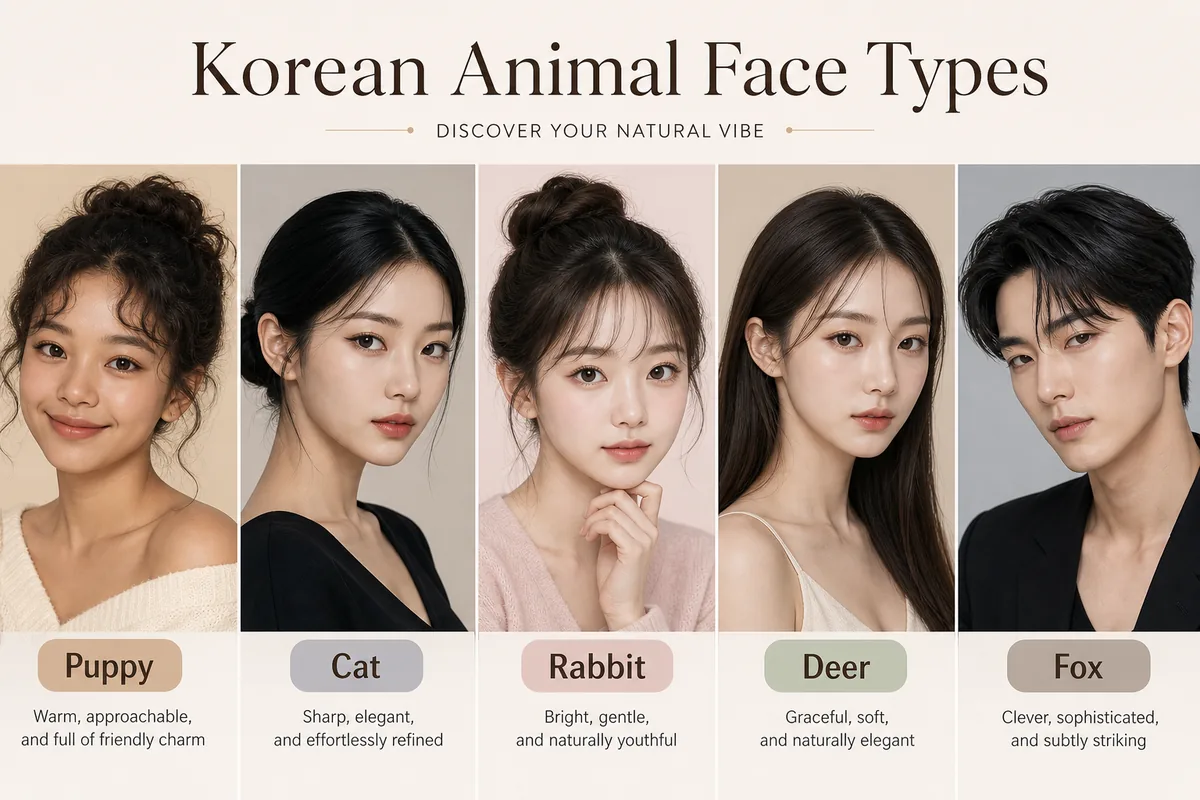
Korean animal face types are visual archetypes used in Korean pop culture, beauty discussion, idol commentary, and online self-description. In Korean, people often use the word dongmulsang, or animal-like face impression, with labels such as gangajisang for puppy face, goyangisang for cat face, tokkisang for rabbit face, saseumsang for deer face, and yeowusang or desert fox face for fox-like impressions.
These labels combine structure and mood. A puppy face is not only round eyes; it is the way soft eyes, gentle cheeks, and an approachable smile work together. A cat face is not only eyeliner-shaped eyes; it is the combination of lifted eyes, cleaner facial lines, and a polished first impression. That is why two people can share one feature but still belong to different animal face types.
The core English SERP usually repeats five types: puppy, cat, rabbit, deer, and fox. Some sources expand the list to include bird, hamster, snake, tiger, or other archetypes, but the five-type system is the clearest starting point for a self-check article.
- Puppy face: soft, friendly, youthful, and warm.
- Cat face: lifted, polished, sharper, and chic.
- Rabbit face: bright, cute, rounder, and sweet.
- Deer face: gentle, elongated, delicate, and elegant.
- Fox face: longer, narrow, mature, and more mysterious.
Step 1: Start With Your Eyes
Your eyes usually create the strongest animal face type signal. This is why Korean animal face type discussions often begin with whether the eyes look round, droopy, lifted, long, gentle, or sharp. You do not need exact measurements. You need to describe the impression accurately.
Round or slightly droopy eyes often support puppy face because they make the face read open and warm. Round bright eyes can also support rabbit face, especially when the rest of the face is short, soft, and youthful. Large gentle eyes can support deer face when the face is longer and the overall impression is delicate rather than bubbly.
Almond or upturned eyes often support cat face. If the eyes are not only lifted but also longer, narrower, and paired with a slim face, the impression can move toward fox. The difference is subtle: cat face often feels sleek and chic, while fox face feels more elongated, mature, and mysterious.
| Eye impression | Possible type | Tie-breaker |
|---|---|---|
| Round, open, friendly | Puppy | Soft jawline and warm smile |
| Round, bright, cute | Rabbit | Shorter face and youthful cheeks |
| Large, clear, gentle | Deer | Longer face and slim lower half |
| Almond, lifted, defined | Cat | Clean lines without strong elongation |
| Long, lifted, narrow | Fox | Narrower face and sharper chin |
Step 2: Check Face Length and Outline
After eyes, face length is the most useful filter. A short, soft, rounded outline usually supports puppy or rabbit. A longer, slimmer outline usually supports deer or fox. Cat can sit in the middle: it often has clean definition and a narrower lower face, but it does not always need the elongated look that fox face usually has.
Look at the whole outline from forehead to chin. Is your face compact and soft? That points toward rabbit or puppy. Is it long and delicate? That points toward deer. Is it long, narrow, and sharper? That points toward fox. Is it defined, lifted, and balanced without strong roundness or strong elongation? That may point toward cat.
This step prevents one of the most common mistakes: deciding from the eyes alone. Someone with big eyes and a long slim face may look more deer than rabbit. Someone with lifted eyes but a balanced, less narrow outline may look more cat than fox.
- Shorter + softer usually supports puppy or rabbit.
- Longer + delicate usually supports deer.
- Longer + narrow + sharper usually supports fox.
- Lifted + defined + balanced often supports cat.
Step 3: Read Your Jawline and Chin
Jawline is the clearest softness-versus-sharpness signal. A soft jawline with gentle cheeks usually supports puppy or rabbit. A slimmer jawline with a more delicate lower face can support deer. A sharper, more angled, or pointed lower face can support cat or fox.
The difference between cat and fox often appears here. Cat face can have a sharp or narrow lower face, but it may still look compact and sleek. Fox face usually feels narrower and more elongated, with a chin and nose line that make the whole face read more pointed.
For soft types, the jawline separates puppy from rabbit. Puppy face often feels friendly and warm, even when the face is not extremely baby-like. Rabbit face usually feels more visibly cute, bright, and youthful, especially when soft cheeks and a smaller nose reinforce the impression.
| Lower-face clue | Likely direction | Why it matters |
|---|---|---|
| Soft jawline, gentle cheeks | Puppy or Rabbit | Softness makes the face feel warm or cute |
| Slim but delicate lower face | Deer | Lightness supports an elegant impression |
| Defined jawline, clean lower face | Cat | Definition supports a chic impression |
| Narrow lower face, sharper chin | Fox | Pointed elongation supports a mature impression |
Step 4: Use Cheeks, Nose, and Smile as Tie-Breakers
Cheeks, nose, and smile are not always the first things people mention, but they are excellent tie-breakers. Fuller cheeks can make a face read younger, softer, and more rabbit or puppy-like. Cleaner cheek planes can make a face read more cat or fox-like. A delicate middle face can support deer when paired with large gentle eyes.
A small rounded nose can reinforce rabbit or puppy. A straighter, finer, or more pointed nose can reinforce cat or fox. Deer face often sits between those extremes: not necessarily sharp, but refined and light. Smile changes the result too. A broad warm smile can pull a face toward puppy, while a bright sweet smile can pull it toward rabbit.
This is also where styling can mislead you. Blush placement, aegyo-sal makeup, winged liner, contour, bangs, and lens distortion can all move the impression. For a baseline self-check, use a low-makeup or everyday-makeup photo before checking heavily styled images.
- Fuller cheeks can strengthen puppy or rabbit.
- Cleaner cheek planes can strengthen cat or fox.
- A delicate, light middle face can strengthen deer.
- A warm smile leans puppy; a bright sweet smile leans rabbit.
- A finer nose and sharper mouth line can make cat or fox more likely.
Step 5: Pick a Primary Type and a Secondary Type
Most people are not a pure type. That is why the most useful answer is often a primary Korean animal face type plus a secondary one. Your primary type is the pattern that appears across the most features. Your secondary type explains the feature that keeps pulling you away from a perfect match.
For example, if you have lifted eyes, a defined lower face, and a polished first impression, cat may be your primary type. If your eyes are also large and gentle, deer may be your secondary type. If your face is soft and friendly but your eyes and smile are especially bright and cute, puppy may be primary while rabbit is secondary.
This two-type method is more realistic than forcing a one-word label. It also helps when you use a Korean animal face types test, because you can compare your top result with your second and third matches instead of treating the first score as the whole story.
| Mixed type | What it usually means | Best styling clue |
|---|---|---|
| Cat + Deer | Lifted or defined features with large gentle eyes | Clean makeup with soft eye emphasis |
| Rabbit + Puppy | Soft, cute, youthful, and friendly at the same time | Fresh blush, natural lips, and open eye makeup |
| Cat + Fox | Sharp lifted features with a more mature or narrow impression | Sleek liner and refined contour |
| Deer + Rabbit | Large bright eyes with both delicate and cute signals | Light eye makeup and soft textures |
| Puppy + Deer | Warm eyes and softness with a longer, slimmer outline | Gentle brows and natural complexion |
Common Mix-Ups: Cat vs Fox, Rabbit vs Puppy, Deer vs Rabbit
The SERP has plenty of type lists, but it rarely spends enough time on confusion points. That is where most readers actually get stuck. The three most common questions are whether a face is cat or fox, rabbit or puppy, and deer or rabbit.
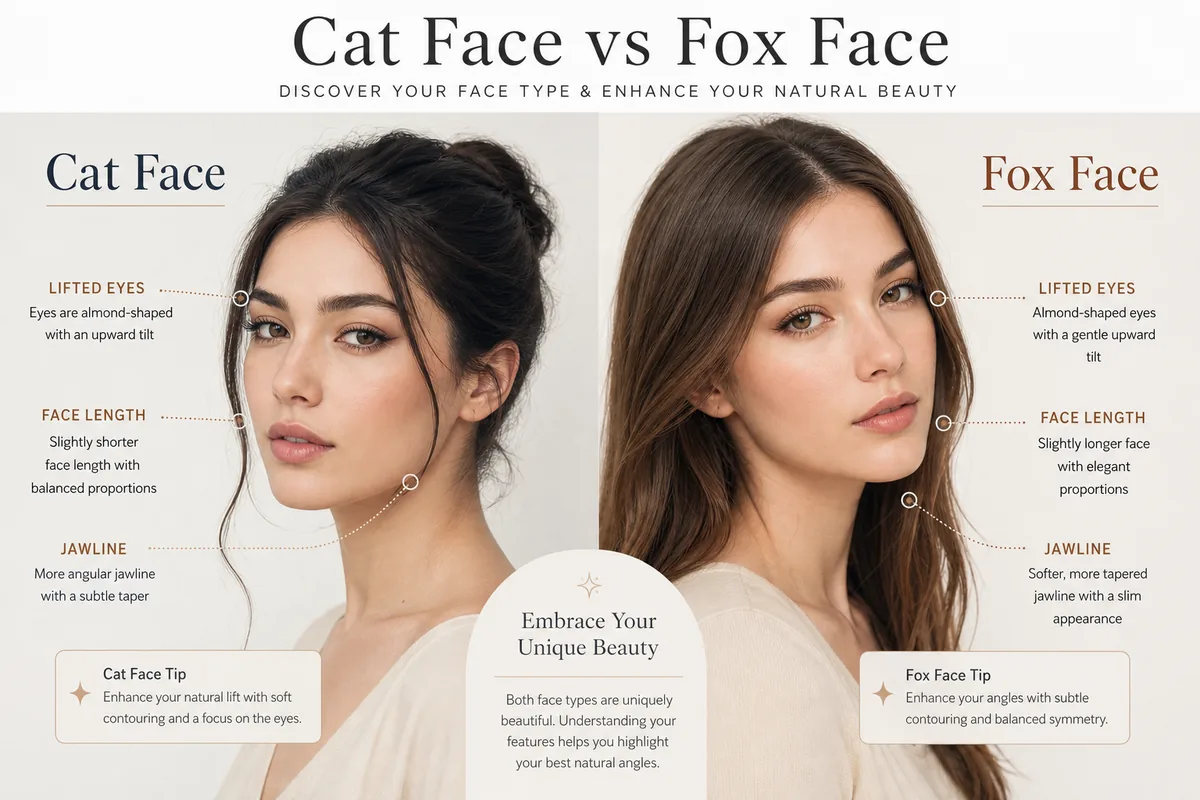
For cat vs fox face type, look for elongation. Both can have lifted eyes and sharper lines. Cat usually reads sleek, chic, and defined. Fox usually reads longer, narrower, and more mature. If your eyes are lifted but your face is not especially long or narrow, cat is often the better fit. If the eye shape, nose line, and chin all make the face feel slim and pointed, fox becomes more likely.
- Rabbit vs puppy: both are soft, but puppy feels warmer and more approachable, while rabbit feels brighter, cuter, and more youthful.
- Deer vs rabbit: both can have large eyes, but deer is longer and more graceful, while rabbit is shorter, rounder, and sweeter.
- Puppy vs deer: both can feel gentle, but puppy is warmer and rounder, while deer is slimmer and more elegant.
- Cat vs deer: both can look refined, but cat is more lifted and defined, while deer is softer, clearer, and more delicate.
Best Photo Setup for Checking Your Animal Face Type
Your photo can change your result more than you think. A wide-angle selfie can make the nose and center face look stronger. A high angle can make the face look shorter and cuter. Heavy filters can blur jawline and cheek clues. Strong contour or winged liner can push the impression toward cat or fox even when your natural baseline is softer.
For the most accurate self-check, use one neutral photo first. Stand or sit facing a window, keep the camera around eye level, relax your expression, and avoid covering your brow, cheeks, or jawline with hair. Then compare it with one smiling photo. If the same type appears in both, that is likely your base type. If the result changes, note which features changed with expression.
- Use natural front light instead of overhead bathroom light.
- Keep the camera at eye level to avoid face-shape distortion.
- Choose one relaxed photo and one soft-smile photo.
- Avoid beauty filters when making your first judgment.
- Move hair away from the jawline and cheek area.
Should You Use a Korean Animal Face Types Test?
A self-check helps you understand the logic. A Korean animal face types test helps you get a structured second opinion. The best approach is to use both: read the feature clues, make your own guess, then upload a clear photo to compare your result with what the tool sees.
The test is especially useful when you are stuck between close types. If you cannot decide between cat and fox, the tool can weigh face length, lifted eyes, jawline sharpness, and proportions together. If you cannot decide between rabbit and puppy, it can compare softness, eye roundness, cheek fullness, and overall facial balance.
On this site, the best next step is the Korean Animal Face Types Test. If you prefer a broader quiz-style page, you can also use the Animal Face Type Quiz. For background reading, the earlier animal face types explained guide gives a wider overview of the trend.
- Use self-checking when you want to understand your features.
- Use a test when you want a quick structured comparison.
- Read secondary matches because they often explain mixed types.
- Treat the result as a style clue, not a final judgment.
Ready to Check Your Korean Animal Face Type?
Use one clear front-facing photo and compare your primary match with your secondary signals. The result is most helpful when you read it alongside the feature checklist in this guide.
Frequently Asked Questions
References and Further Reading
-
Koreaboo - Here Are The 5 Types Of Animal Faces That Female Celebrities HaveReviewed for the recurring five-type structure and celebrity-oriented examples in English SERP results.Open source
-
Pasiloca - What Are the Korean Animal Face Types?Reviewed for broader Korean animal face type descriptions and recurring feature language.Open source
-
The Korea Times - Do you have a K-face?Used for cultural context around Korean appearance language and the social meaning of labels such as cat face and dog face.Open source
-
Daum / bnt - 얼굴상에 따른 다채로운 메이크업Reviewed for Korean beauty-language usage connecting face impression types with makeup advice.Open source
-
Freudly - Animal Face Type QuizReviewed as a quiz-style SERP competitor that frames animal face type results as fun and non-judgmental.Open source
-
face-type.com - Animal Face EncyclopediaReviewed as a test-plus-encyclopedia competitor covering animal face categories.Open source